


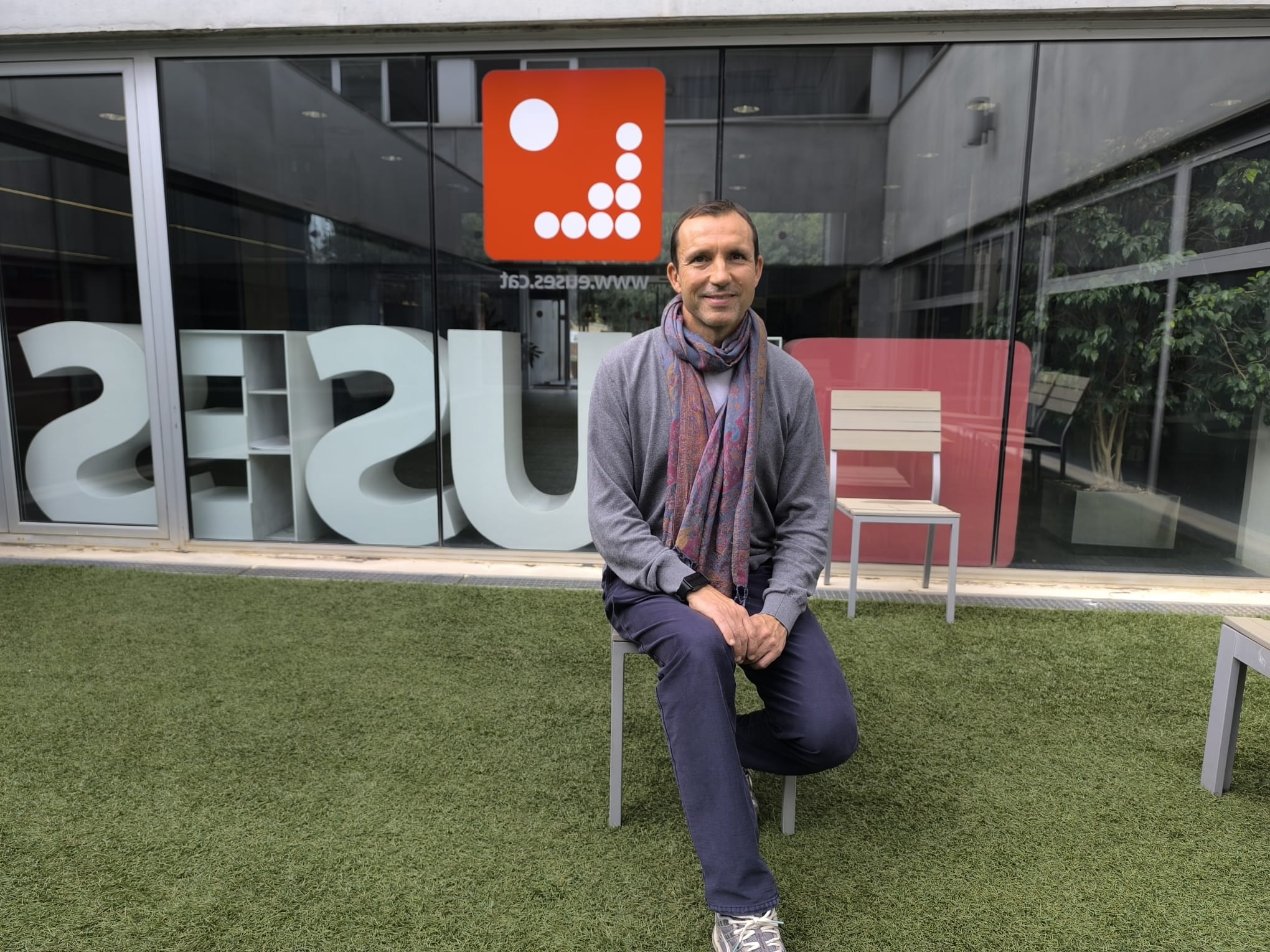
Rafel Magrinyà has been the Academic Director of EUSES since 2012, after having directed the Degree in Physical Activity and Sport Sciences between 2009 and 2013. He is also the Quality Director of EUSES Terres de l’Ebre, a center affiliated with the Rovira i Virgili University, and of ENTI, a center affiliated with the University of Barcelona.
With a degree in Physical Education, a Master’s in High Performance Sport, and a national football coach qualification, before fully entering the university sector he developed a career linked to public sports management at the Catalan Sports Council of the Generalitat de Catalunya, and to elite sports, particularly at Nàstic de Tarragona and FC Barcelona.
Currently, he focuses much of his activity on the academic development of the centers, quality and accreditation processes, the implementation of new study programs, and the growth planning of the different campuses.
Fourteen years as academic director. Has the picture of EUSES changed much since you landed at the Salt campus?
A lot. In fact, I have been linked to EUSES since 2009 and I have been academic director since 2012. When we started, the project was much more focused on the Degree in Sport Sciences (CAFyD) and the Salt Campus.
Today we have a much broader reality: Sport Sciences, Physiotherapy, Nutrition, postgraduate training, a consolidated project in Terres de l’Ebre, and the International Physiotherapy Degree in Barcelona. But the change is not only quantitative. We have grown in programs, faculty, internationalization, quality, research, and infrastructure.
The challenge now is to grow while maintaining what identifies us: training based on scientific evidence, learning by doing, a lot of practical experience, closeness to the student, and links with the professional world.
Three consolidated campuses in a clear stage of growth. Any clear future goal in sight as a group?
Yes, but the goal is not to grow for the sake of growing. What we are trying to do is consolidate a university project specialized in health, sport, and technology, ensuring that each campus has the capacity to evolve in accordance with its environment.
In Salt, we are clearly reinforcing the field of health sciences; in Terres de l’Ebre, we are working on two very important projects: the implementation of Sport Sciences in the city of Tarragona and Dentistry in Amposta; and in Barcelona, the new 22@ campus opens up many possibilities for growth and, above all, transversality between health and technology.
Let’s start with Salt. Extension works are currently underway that will add more than 1,500 square meters. How will these spaces be optimized?
It is a very important intervention because it is not simply about gaining square meters, but about reorganizing the entire center. The new floor will allow us to create new classrooms, relocate services, and, at the same time, free up spaces in the current building to respond to more specific teaching needs.
Right now, we must address the growth of the recently implemented Degree in Human Nutrition and Dietetics, the transversal needs of Sport Sciences and Physiotherapy, and, at the same time, prepare the center for the future. In this sense, we are in the verification phase for the Degree in Dentistry.
In addition, we have acquired a new facility very close to the teaching building where the future University Dental Clinic is planned to be developed. Therefore, these are not isolated actions: they form part of medium and long-term campus planning.
All this coincides with the future Health Campus and the new Josep Trueta Hospital. How can EUSES fit into this?
All this is happening at a very special time for Salt and Girona. The future Health Campus and the new Josep Trueta Hospital should reinforce a top-level healthcare, teaching, research, and innovation ecosystem in the territory.
EUSES is very close both physically and academically, and it is clear that our future development must engage in a dialogue with this environment: training professionals, generating knowledge, and seeking synergies with healthcare and university agents in the region.
There are also very important developments at EUSES Terres de l’Ebre and in Tarragona…
Yes. In this case, we have two parallel projects that are strategic.
On one hand, the curriculum of the Degree in Physical Activity and Sport Sciences has been modified so that the degree can also be implemented at the Campus in the city of Tarragona. We are now working to guarantee the necessary infrastructure so that this implementation can begin in the 2027-2028 academic year.
On the other hand, the Degree in Dentistry at EUSES Terres de l’Ebre already has its curriculum verified, and we are also working with the horizon of the 2027-2028 academic year to implement it in Amposta. This second project involves a highly significant intervention in facilities and services: expansion of teaching spaces, specific laboratories, and, above all, the future EUSES TE University Dental Clinic.
These are demanding projects because they require the incorporation of human resources, equipment, and specific services, but they also have a very clear territorial vocation. The idea is for university growth to generate educational opportunities and, at the same time, have an impact on the territory.
And the International Physiotherapy Degree in Barcelona has also taken a major leap forward this academic year…
Yes. This academic year we started teaching activities in ENTI’s new building in the 22@ district. This is a very important change because we became part of a new campus, with greater teaching and laboratory capacity, right in the heart of Barcelona’s technological district.
The degree remains an inter-university program between the University of Girona and the University of Barcelona, with EUSES and ENTI, but this new environment should allow us to go beyond just sharing a building: we want to generate more synergies between health and technology, share resources, and progressively promote joint teaching and research projects.
What and who makes all these investments possible?
Behind this is a very clear commitment from the ownership group to the university centers and a long-term vision. But there is also a prerequisite: the projects must make academic sense.
First, we identify teaching needs, new studies, or growth opportunities, and then we plan the infrastructure to make them possible.
In a university institution, an investment only makes sense if it ends up improving student training, faculty conditions, research, or the relationship with the territory.
EUSES-UdG has maintained its position in the world’s TOP-150 in sport sciences in the Shanghai Ranking for years. Is this one of the group’s great assets?
It is an important asset, especially because it is not a one-off recognition. Being among the top 150 schools, faculties, and departments in the world in sport sciences provides international visibility, but above all, it is a consequence of the research work and the capability of our groups and researchers.
For me, the value of the ranking is not being able to say “we are top-150,” but rather seeing that a relatively small center can progress in an environment as demanding as research if it has a clear line, good researchers, and a close relationship with the university.
Furthermore, for the past few months, we have been working on creating a Knowledge Transfer Office, with the goal of further boosting research, facilitating the transfer of results to the professional and business sectors, and generating new collaboration opportunities between our researchers, institutions, and the productive environment.
As an affiliated center, you also have to manage relationships with UdG, UB, and URV, navigating the peculiarities of each university.
Yes, and each university has its own culture, procedures, and way of working. With UdG we have EUSES Salt and the inter-university degree in Physiotherapy; with URV, EUSES Terres de l’Ebre; and with UB, ENTI.
This requires a thorough understanding of university systems and the processes of verification, modification, monitoring, and accreditation.
A significant part of my job consists of adapting the internal dynamics of privately-owned centers to the procedures, guarantees, and academic demands of the public universities to which we are affiliated and the corresponding university quality agencies.
It is a job of constant alignment: transforming an academic need of the center into a project that meets all the requirements of the university system while, at the same time, being viable and useful for students.
However, your day-to-day life goes much further than that.
Yes. Academic management today is highly transversal. You can start the day discussing a curriculum, then review an accreditation, a staffing need, or building works, and end up talking about internationalization, internships, or a new research project.
Over the years, I have gone from having a responsibility very focused on Sport Sciences to having a global vision of the centers. And that is probably the part I like most: trying to make all these pieces fit together.
And you still find time to coach Nàstic Genuine. Is it your escape valve?
It is an escape valve, but it’s much more than that. Ten years ago we started a project that we thought would be much smaller, and it has ended up having a huge impact.
Genuine reminds you of very basic things that we sometimes forget in our professional day-to-day lives: that everyone needs to feel they belong to a team, that success is not always measured by the result, and that giving an opportunity can transform a person.
And, obviously, after a very intense week of meetings, documents, and university management, arriving at a Genuine training session completely changes your mindset.
This 2026, the captains of Nàstic Genuine were chosen to give the opening speech (pregoners) for the Santa Tecla festivities. How did you experience that?
With a lot of emotion. Álvaro and Rubén have been two of the symbols of the project since day one, and seeing them on the City Hall balcony giving the Santa Tecla opening speech is an image that perfectly explains what Genuine has meant.
It is not just football. It is visibility, normalization, and creating spaces where everyone has the same opportunities to participate, be recognized, and feel part of society.
Seventeen years linked to EUSES, fourteen as academic director, and ten years with Nàstic Genuine. Are you a person for long-term projects?
Yes, probably so. I like to see projects grow. When I started at EUSES, it was impossible to imagine the reality we have today, and when we started Genuine, we couldn’t imagine all that it would end up transforming either.
But for a project to have longevity, just staying there for many years is not enough. You must be able to keep transforming the project, listen, bring in people who know more than you do in many areas, and accept that you need to innovate and constantly adapt to what society demands of you.
Loyalty, to me, is not standing still in one place; it is remaining committed to a project while that project evolves.

